


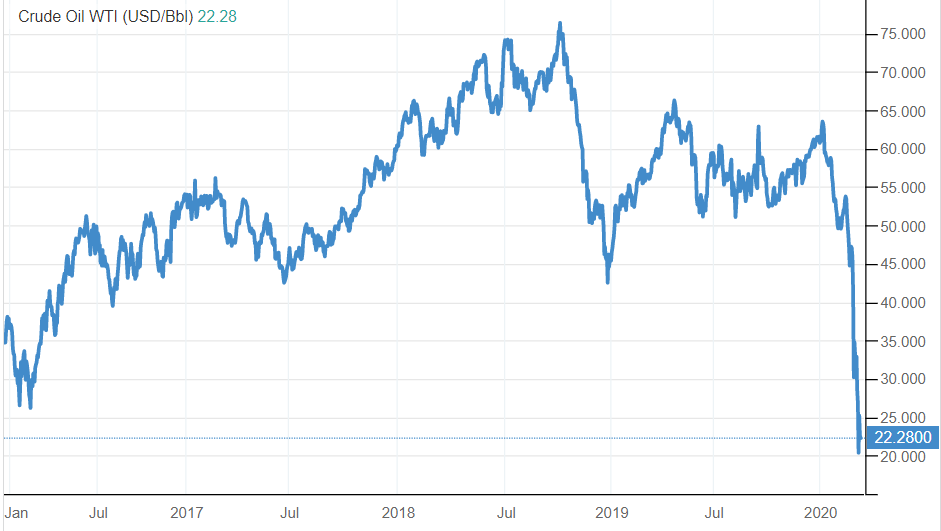
Since the beginning of last week the oil prices have been crashing and reaching 30-year lows, with WTI bottoming out at $20.83 and Brent at $26.45 on Wednesday. It is important to say that the pricing factors here are not really coronavirus-related (although reduced demand due to the virus economic impact is also in play here). The true reasons behind this unseen (in a while) volatility is more of a political game (played by way of the popular price-war mechanics usually applied in the corporate world). Since Russia refused to prop up price with further output cuts (earlier in March at an official OPEC+ meeting in Austria), Saudi Arabia decided to speed things up by massively slashing its oil export prices across the board. The price war, mentioned above, is effectively waged against the US shale oil business, which has been expanding for the better part of the last decade. Now, the first impression would be that investors will be hurt in the markets and that this is yet another asset class (in the case – commodity), which is failing market players, amidst coronavirus concerns and wider economic meltdown. If you think about, however, you could see the benefits of this particular price crash – it would be easier for businesses and economies to recover at these energy costs (since gas is also affected in a similar matter), than at the average (in the last few years) oil price range of $50-70 pb.

It is no secret that global oil demand has been decreasing for the last few years, in light of the Paris Treaty and switch to renewables and/or gas. Furthermore, even before the coronavirus outbreak, the global economy had been showing signs of slowdown and potential recession, which of course ultimately leads to negative demand shift in the energy markets. Adding the coronavirus (estimated 5-7 Mb/d demand drop in China alone) on top of all that gives you the perfect storm – the current reserve building (due to low demand) will further pressure prices even after the global economy (incl. China’s) restarts. But I digress – let’s go back to the problem at hand.
Russia’s argument is that they would not further risk losing market share to shale producers (by way of reducing outputs to prop up global prices, which the US shale industry has never done) and that they have sufficient fiscal buffer (in the face of dollar reserves and even gold) to weather the storm – don’t forget that this WAS their position in a market reality of $40-50 pb and their strategy may have not factored in Saudi Arabia’s radical response in speeding-up the process. Most frackers (shale industry) explore the so called tight-oil fields, which are technically hard and unfeasible to tap under conventional drilling practices. Even so, according to many analysts, the costs incurred by the shale sector (per barrel produced) normally lie in the $50-80 range. So, Russia’s logic is: let them frackers go bankrupt, so that supply-side shrinks naturally, and prices will automatically go up. Now bear in mind that the shale industry is made up of a lot more fragile entities, especially in comparison to the well-known Standard Oil remnants (incl. Chevron, Exxon, Texaco, etc.), as well as other old oil giants such as BP, Total and Shell. Despite that higher production costs, we mentioned above, the fracking industry has another problem – there are still heavily indebted (after all most of them did not even exist 10 years ago). According to some research done by the Fed, companies from the sector (situated mainly in the Permian basin) have accumulated bank debt of over $300 billion, most of which is due at different points within the next 2 years. At the current market and credit situation, many of these entities may not be able to re-finance this debt (esp. while operating at a loss), which will eventually lead to bankruptcies and asset liquidation (per Russia’s plans and expectations above), including exploration and drilling sites, equipment, infrastructure and transportation. So unless the US government decides to intervene, which might be hard to pull-off with the coronavirus social, healthcare and economic impact currently unfolding, those weakest leaks of the industry will fall – they just don’t have the cash to weather the storm. Of course, many of the US fracking business were bought out by Big Oil in the last 2-3 years, which automatically implies that those will persevere (as Big Oil can afford to operate at a loss). Currently, hedging contracts are still keeping those entities afloat, but this short-term fail safe will not last long. Also, it is important to know that the Fed are not allowed to directly purchase corporate debt, so that option is out of question and some other approach (if any) will have to be employed here.
Obviously, the above analysis paints a rather grim medium-term picture for the sector (esp. in the US) and the supply and demand in the oil markets (in general). Bear in mind that this is all happing against the backdrop of global recession, failing supply chains, diminished production, low exports, bursting asset bubbles and potential credit crisis (with low liquidity, increasing spreads and rising probability of corporate defaults). Trading in the O&G markets (equally true for other asset classes), particularly via short-term speculative strategies, should be implemented carefully and at low volumes (in line with current volatility). It is currently hard to see oil prices (esp. WTI crude) breaking the $35-40 pb milestone in the near future. Some investors are considering getting in the market due to the obvious price incentives. Any aggressive market entry at the moment would probably be a mistake, since current volatility is high, we are not sure if the market has bottomed out (some analyst are discussing the possibility of short-term negative price levels, which is actually a thing, as crazy as it sounds) and the temporal horizon of such an invest might be pretty long-term (depending on the investor’s preferences this might be an issue, especially for margin traders/investors with limited resources and multiple asset-class positions). A more gradual market-entry approach might preferable (it also wouldn’t hurt if price-protection put-option strategies are in place) – O&G-related ETFs are might also a good instrument to consider. If the O&G investments are a must in your portfolio, perhaps looking at the Big Oil equities could be an option – some of these are down over 35% (12 months TD) and could present good buy opportunities. Big Oil should be able to last a lot longer, in the current market conditions, compared to the smaller independent shale companies (as discussed above), especially the ones that are still investing in exploration of new drilling sites. The downstream segment of the sector (esp. refineries) are better positioned in the current situation, since their short-term margins are actually improving (per the low crude prices) – thus, their shares could be considered as well; although, those higher margins cannot be maintained forever and most of their supply-side gains will have to be passed along to the consumers (by way of the petrol end-products).