
Stimulus, economic recovery and inflation (Part III)
It’s worth diving into some themes which have emerged recently, as the world is trying hard to get rid of COVID-19 and go back to the old normal, or at least as close as it gets.
Reflation trade
This phrase has become quite popular lately and it is worth digging into its meaning and implications for investors. Reflation relates to economic output expansion, fuelled mainly by fiscal and/or monetary stimulus, which we’ve had a lot of lately. With COVID-19 vaccines and drugs rolling out, economic growth prospects have returned. Investors are building up confidence that the next upward-trending economic cycle will soon be upon us, which leads to capital reallocation out of bonds [esp. low and negative-yielding ones] and into equity. Note that reflation is different from inflation. Reflation is more about growth driven by improving demand, after a severe economic cycle trough caused by a recession. However, many investors and analysts believe that reflation could turn into inflation eventually, although recent low-inflation and low-growth trends in a technology-driven economy suggest that this might not be the case at all.
As suggested above, in times of economic growth, price increases, and higher bond yields investors tend to pivot to equities and increase their risk exposure, which implies rotating out of bonds [esp. if they are not classified as TIPS]. Cyclical sectors and small-cap stocks [like the ones in the Russel 2000 Index] are the preferred long trades, but not necessarily in the long-run. Reflation trade rotation usually involves exiting growth stocks and gradually moving into value stocks [probably at attractive valuations too], the logic being that interest rates are currently at historic lows and have only one way to go in the mid-term – up. Looking at undervalued share in the Travel & Leisure and Airline sectors might also be a good idea. With the yield curve now normalizing, some bonds of longer maturities might even do the trick, yield-wise. But keep an eye on inflation. Reflation trades were popular back in 2009-10 after the apocalyptic financial crisis, but some value investors did not generate the returns they expected, with general inflation levels and economic growth remaining relatively low since the Credit Crunch. The arguments for the current reflation trade strategy are further boosted by the recent Blue Wave victory in the US, which effectively secures further government stimulus [probably in the neighbourhood of $1-1.5 trillion] focused on rebooting aggregate demand and with it – economic growth [estimate at around 5-7% for the US in 2021].
Of course, reflation trades can be quite risky. Vaccinations might not cover enough ground, new virus mutations might come out, demand boost might not materialize in actual economic growth, and raging inflation could occur and eat up real returns [although interest hikes by central banks will probably keep inflation rates reasonable].
Fiscal stimulus and bond yields
Generally, bond yields go down as demand for government debt goes up and investors buy into the safe-haven asset. Bonds reduce portfolio risk, esp. in times of economic turmoil, which is why we saw a massive yield drop in 2020. Actually, bonds should always be part of our portfolios for risk management purposes – the most popular portfolio allocation strategies are 60:40 and 70:30 assets-to-bonds split.
The recession response is usually government stimulus (via fiscal instruments) and central bank assistance (via monetary policy tools). Governments usually support the labour force and businesses to boost aggregate demand and keep suppliers afloat. Central banks usually manipulate base rates and purchase assets from commercial banks (usually bonds) to safeguard financial markets liquidity and indirectly provide funding to corporate borrowers.
Per the above, with the reflation trade in play, investors rotate out of bonds and into the riskier equity markets, especially if they believe that economic news and prospects are positive, and stimulus measures are strong enough. Thus, the recent rise in benchmark yields is good news for equity markets.
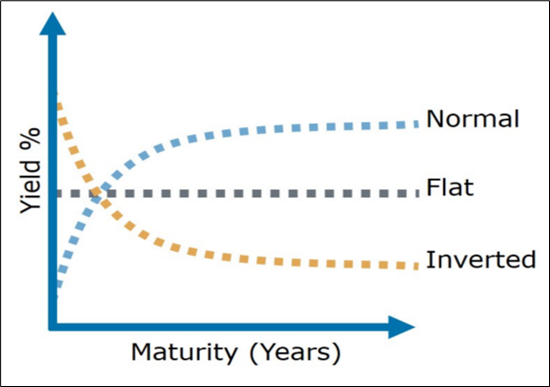 We saw earlier this year and late in 2019 that bond yields have forecasting powers in predicting imminent recessions via the inverted yield curve phenomenon, driven by higher short-term yields and lower long-term yields. Per the graph, normally yields distribution should be reversed. One of the factors leading to an inverted curve is the fact that investors turn to long-term bonds, anticipating economic turmoil in the short-term, despite the associated higher risk (due to longer maturities), thus boosting those bond prices and crushing LT yields.
When central banks have killed the base rates and are purchasing billions worth of assets (daily), they are running out of combat tools, which is why governments tend to introduce several tranches of fiscal stimulus throughout the crisis cycle to assist with the demand side of recovery.
With further news of new fiscal stimulus prospects, bond yields will rise even more. Gold prices should also go down, being a safe haven asset, unless investors expect (above target) inflation in the short-term. Vaccine news and fewer new COVID cases/deaths will further boost investor confidence and risk appetite. With yields going up and stimulus remaining in play, investors will expect demand to rise, production to normalize, unemployment to subside – the foreign investors’ demand for the country’s currency will increase as local bonds and stocks become attractive [in terms of yield and bullish momentum]. The rise in currency demand usually results in [short-term] appreciation against other foreign currencies via the money market’s supply-and-demand rebalancing. However, inflation levels could potentially catch up due to demand recovery and money supply boost [stimulus driven]. This will bring about an interest rate hike (as central banks strive to contain inflation), which will, in turn, affect borrowing costs (both private and corporate). Debt servicing and repayment at highly leveraged companies (and individuals) will become problematic, with default risks going through the roof. Market prices will most likely drop, with investors losing confidence in those entities. If this happens in the aftermath of a deep recession and unprecedented stimulus, it could lead to a domino effect of bankruptcies, insolvencies, and even delistings, with creditors and [reinvigorated] investors taking massive losses along the way.
Budget deficits and inflation
Thanks to Keynesian Economics, it is OK for countries to run budget deficits. Budget deficits occur when governments are spending more than they collect in tax revenue. This is usually fine since governments can fund those deficits with borrowing [both foreign and domestic]. However, during economic turmoil governments tend to engage in fiscal stimulus in an effort to support businesses and citizens in weathering the storm and reboot aggregate demand. When the recession is as deep as the 2020 one, deficits could be quite high, especially in the face of falling GDP. Standard means of borrowing may no longer be applicable beyond a certain point, which means that the central bank will have to act as a sort of creditor of last resort to the government. This transaction would imply purchasing government bonds and increasing the money supply [printing money] on top of what the central banks would have already pumped into the economy as part of their stimulus programs [i.e. purchasing assets from commercial banks and in the markets]. A prolonged increase in money supply would normally lead to an inflation rate increase, especially in countries that rely heavily on imports. Therefore, we can conclude that large government deficits are usually an indicator of inflation in the short-to-mid-term. It’s worth noting that theoretically high budget deficits could also have a negative impact on private borrowing and investing, corporate and income tax rates, interest rates [usually via inflationary effects], and corporate capital structures.
This concludes our series on economic fundamentals, investment behaviour, business cycle, and current hot topics. Hopefully, the information in these articles was useful and will help you improve your investment strategy and market positioning.


